Precise. Smart. Efficient.
Into the future with digital temperature control.
Our intelligent heating solutions for innovative packaging
innovative
heating solutions
Semiconductors
watttron’s high-speed, ultra-precise heating systems achieve accurate temperature control in sub-Kelvin (less than 1 Kelvin) units.
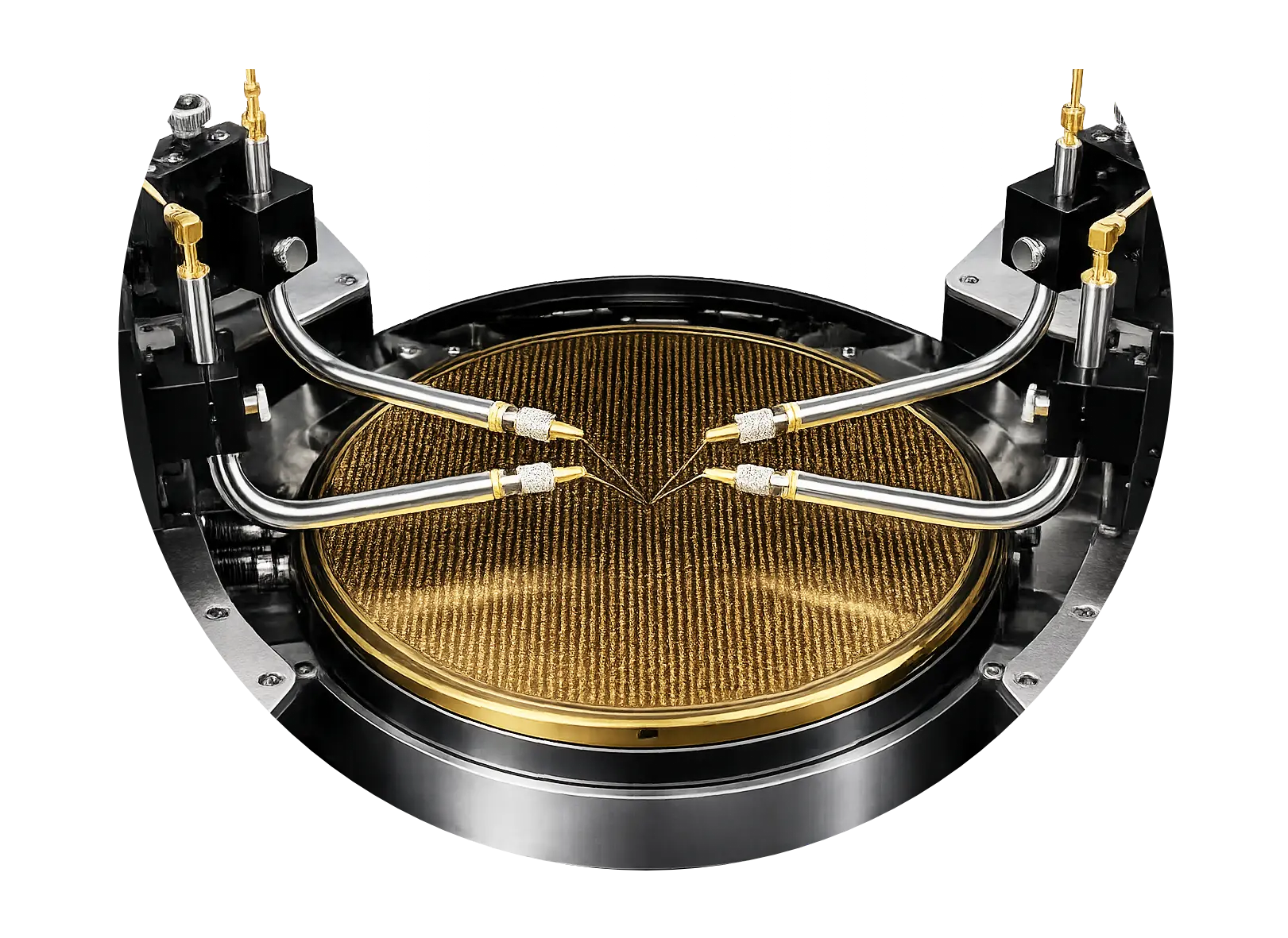
Our digital heating technology is an innovative heating system that enables localized and precise temperature control through an array of individually controllable heating pixels.
These heating pixels also function simultaneously as temperature sensors, allowing for real-time control of temperature distribution.
While this innovative technology was originally developed for plastic processing in consumer packaging, it is also an ideal solution for semiconductor applications that require extremely precisethermalmanagement.
For example, inwafer (wafer) processing and the manufacturing of microelectronic components, accurate temperature control is essential to ensure product quality and yield.
With advancements in advanced packaging (3D integration, hybrid bonding) and miniaturization, managing thermal warpage and dimensional changes has become a critical process challenge affecting yield.
watttron’s digital heating technology offers an approach different from conventional integrated heaters by making the in-plane temperature distribution itself the design target for this challenge.

Key Features
- Temperature accuracy of 0.1 °C per pixel
- Heating rates of up to 850 °C/s
- Cooling rates of up to 100 °C/s in combination with cooling elements
- Temperature range from -40°C to 700°C
- Temperature gradient of up to 280 °C per cm
- Heating power density of up to 180 W/cm²
- Low outgassing properties for cleanroom and ultra-high vacuum (UHV) environments
- Modular and scalable system design
- Integrated temperature sensor
Full-Contact Wafer Probing
Achieves fine-grained temperature control with spatial resolution, even in the presence of external heat sources.
Benefits
- Accurate temperature maintenance even under the influence of external heat sources
- High power density of 180 W/cm²
- Integrated temperature measurement function with spatial resolution
- Reduced response time due to very small thermal mass
Post-Exposure Bake (PEB)
Heats and cools while maintaining high temperature uniformity.
Benefits
- Hot plate and cold plate for PEB
- Integration of hot plate and cold plate functions due to low thermal mass
- Achieves uniform temperature conditions of less than 0.1°C, regardless of size
- Heating and cooling with excellent temperature uniformity
Temperature uniformity in PEB is directly linked to the critical dimension uniformity (CDU) of the resist. By maintaining less than 0.1°C across the entire wafer, in-plane variations are suppressed.
Hybrid Bonding and Thermo-Compression Bonding (TCB)
A temperature control system with high-speed heating and cooling rates.
Benefits
- Extremely fast heating rate of 850°C/s
- Fast cooling rate of 100°C/s with air cooling
- High allowable pressure
- Closed-loop control (feedback control) with a control frequency of 100Hz
By accelerating heating and cooling, the cycle time per bond is reduced, contributing to improved throughput (UPH).
Warpage Correction
A heating system for correcting warpage of wafers and substrates.
Benefits
- Warpage correction through temperature profile control
- High temperature gradient exceeding 250°C over a distance of 1cm
- Closed-loop control (feedback control)
In panel-level packages (PLP) and large-area substrates, warpage becomes more pronounced as the area increases. A key feature of this system is its ability to use the temperature profile itself as a means of correction.
Glass Substrates
Benefits
- System for uniform heating to every corner
- Achieves high temperature uniformity of less than 0.1°C, right up to the edges of the substrate
- Supports a wide temperature range from -40°C to 700°C
Packaging
watttron‘s innovative heating and control technology not only allows industrial applications to be designed with higher precision but also enables economical and resource-efficient operation.
Key Features
- Precise and localized heating per zone
- Advanced sensor technology
- Digital process intelligence
- Compact, modular heating system
Since the enforcement of the Plastic Resource Circulation Promotion Act, domestic food and daily necessities manufacturers have accelerated the shift to monomaterialization (e.g., mono-PP). However, monomaterials have a narrow sealing temperature range, making it difficult for conventional heaters to achieve both stable quality and high production speed. watttron's digital heating technology solves this "narrow process window" with pixel-level temperature control.
Packaging
Sealing Technology (Heat Sealing)
Our cera2seal® heating system is designed specifically for sealing processes.It is the first in the world to enable complex and irregular packaging shapes.It also supports circular shapes with various diameters and widths, as well as custom-contoured sealing bars tailored to your specifications. This is achieved by the free configuration and arrangement of individual heating circuits.
- Precise surface temperature control
- Freely configurable heating zones
- Supports complex and custom sealing geometries
- Integrated temperature sensor
- Temperature profiling
Key Features of Digital Heating Technology
Temperature Control
Direct and precise temperature control at the surface ensures reliable processing of temperature-sensitive materials, even with extremely narrow process windows.
Continuous temperature measurement and intelligent control ensure constant temperature, regardless of changes in cycle time, machine downtime, or operating conditions.
The result is a stable process, highly reproducible results, and the highest standards of quality.
Temperature profiling
The temperature zone setting function improves sealing quality at critical points such as triple pointssmall bags3multi-layer overlaps)and layer transitionssmall bagssteps). It also allows for different heating in areas of2layered materials4and single-layer materials. To make packages (e.g., yogurt cups) easier to open, a deliberately lower temperature can be set only in the area of the opening tab.
Packaging that is easy for seniors to open (easy-peel) is a factor directly linked to product evaluation for domestic food manufacturers. Temperature profiling makes it possible to design a seal that is weaker only at the opening without reducing overall seal strength.
Sealing Applications
watttron offers digital sealing systems for key packaging machinery and applications. Pixel-level temperature control achieves extremely high precision, forming the basis for integrated in-line quality control.
HFFS
Sealing tools for HFFS applications and machines (Horizontal Form-Fill-Seal systems /horizontal pillow packaging machines[. Linear and rotary.]) .Linear (direct drive) and rotary types.
Applications: Liquids, pastes, and dry products such as food, cosmetics, and pet food.
- No loss during startup
- Reliable sealing of film overlaps (e.g., standing pouches and gusseted bags)
- Reliable zipper sealing
- In-line quality control: Detection of product entrapment, wrinkles, or pouch misalignment
- In-line Quality Control: Sealing heads for FS applications and machines (Form-Seal machines / forming and sealing machines).
FS
Seal heads for FS applications and machines (form-seal machines / forming and sealing machines).
Applications: Food (dairy products, snacks), non-food (cosmetics, pharmaceuticals), and pet food.
- No loss during startup
- Potential energy savings of up to 50%
- Compatibility with various lidding materials (e.g., aluminum or PP lids) with a single sealing head (no need to change sealing heads for different materials)
- Integrated in-line quality control function
- Reduction of opening force (peelability) by locally adjusting the sealing temperature around the opening tab, or compensation of sealing pressure differences by adjusting the temperature profile (temperature profiling function)
It allows you to meet monomaterial compatibility and energy-saving requirements while minimizing capital investment.
, pouches, sachets
VFFS
VFFS(small bags)), stick pack applications and machinerysmall bags/ /Main applications:Dry and liquid (wet) applications for food, pet food, and non-food products.)
Monomaterial processing while maintaining constant production capacity
- No loss during startup
- Potential energy savings of up to 50%
- Reliable zipper sealing
- In-line quality control: Detection of product entrapment, wrinkles, or pouch misalignment
- Fast heating and cooling
- Easy integration into machines
- Improved quality and performance
- Heating System cera2seal®
cera2seal® heating system
Extremely precise sealing process through digital zone-based temperature control. This technology enables high sealing quality, high process reliability, and efficient processing even for demanding packaging materials.
Packaging
Thermoforming of rigid containers
watttron provides digital surface heating systems for thermoformed packaging. Pixel-based temperature control achieves extremely high precision, allowing for the intentional control of material flow (material flow) and, consequently, wall thickness distribution.
FFS trays
By optimizing wall thickness distribution, resin consumption can be reduced while maintaining the necessary strength. Lightweighting of container packaging is a direct means of reducing plastic usage. Applications: Deep-drawn rigid trays in sectors such as food, pharmaceuticals, medical technology, and industrial products.
Laminating Pulp Mold or Corrugated Packaging
Lamination of molded pulp or cardboard packaging
Applications: Laminated packaging with high deformability for cosmetics, coffee, and other high-quality food products.
Packaging
Packaging
Monitoring and Inline Quality Control
watttron’s digital solutions enable real-time monitoring and analysis of the sealing process. Monitoring and inline quality control lead to data-driven process optimization, early defect detection, and the highest level of process safety.
Monitoring
Missing, double-placed, or misaligned liners.
- Liner adhesion to the heating element
- Product contamination or entrapment in the sealing area
- In-line Quality Control
In-line quality control
Step 1: Control:
- Visually supported heater programming. Step 2: Function Monitoring: Mapping of the current manufacturing process and error monitoring.
- Step 3: Power Monitoring: Measuring the system’s current power consumption and detecting anomalies in the manufacturing process.
- Step 3:Power monitoring: Measures the current power consumption of the system to detect anomalies in the manufacturing process.
150 North Michigan Avenue
Chicago, Illinois 60601