


Semiconductors
Innovative Applications
Watttron’s fast and extremely precise thermal management enables exact temperature control down to the sub-Kelvin range.
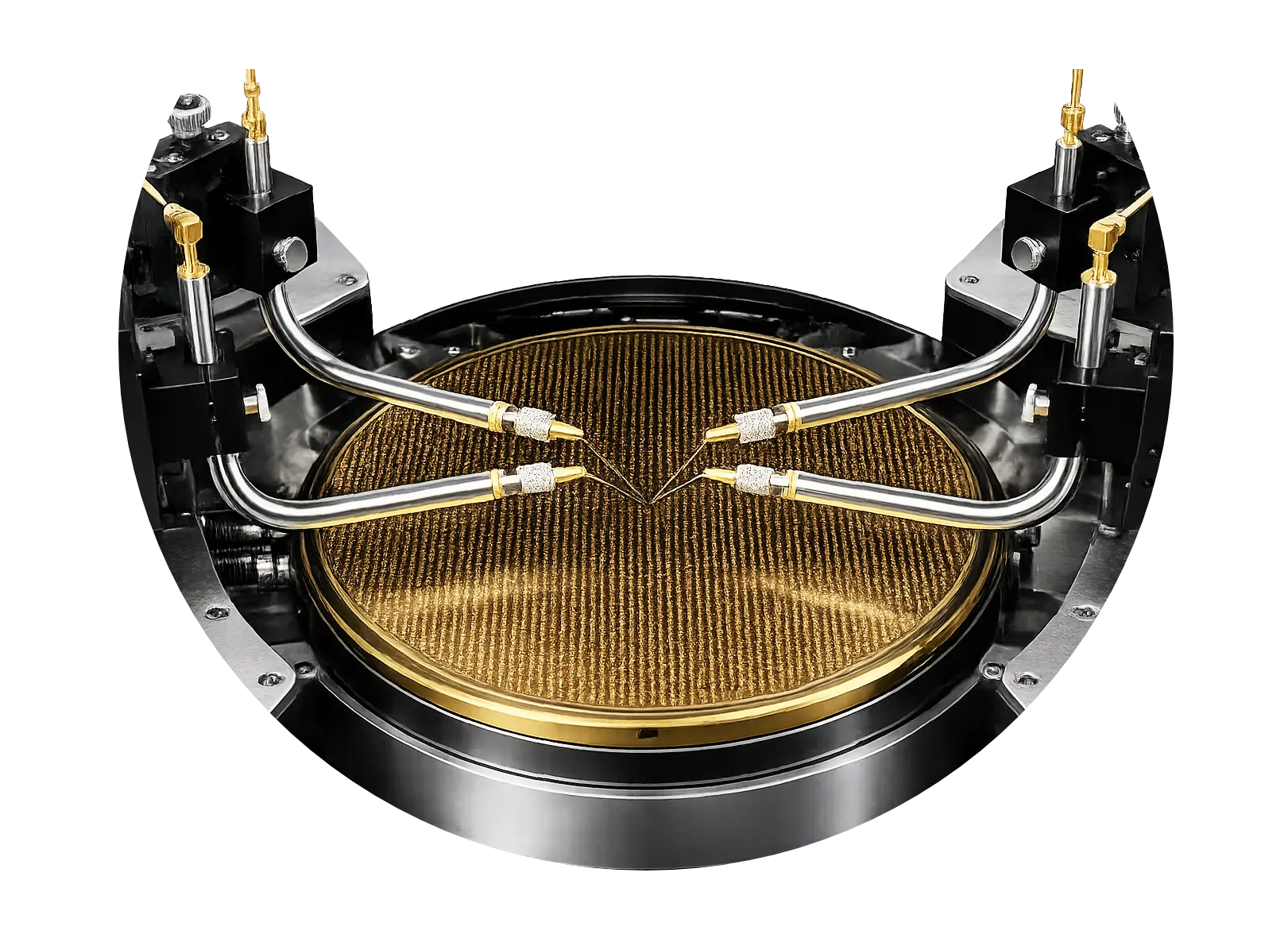

Full Contact Wafer Probing
Spatially resolved temperature control, even with external heat sources
Advantages
- Precise temperature maintenance, even with external heat sources
- High power density of 180 W/cm²
- Integrated, spatially resolved temperature measurement
- Short response times due to very low thermal mass
Post Exposure Bake
Heating and cooling with high temperature homogeneity
Advantages
- Hot and cold plate for PEB
- Combination of hot and cold plate due to low thermal mass
- Homogeneous thermal conditions of less than 0.1°C, independent of size
- Heating and cooling with high temperature homogeneity
Hybrid and Thermocompression Bonding
Temperature control systems with fast heating and cooling rates
Advantages
- Extremely fast heating rate of 850°C/s
- Fast cooling rates with air cooling of 100°C/s
- High permissible pressures
- Closed-loop control with 100 Hz control frequency
Warpage Correction
Thermal systems for distortion correction
Advantages
- Correcting warpage through the temperature profile
- High temperature gradients of over 250°C over a distance of 1 cm
- Closed-loop control
Glass Panel Processing
Advantages
- Homogeneous temperature control solutions down to the last corner
- High temperature homogeneity of less than 0.1°C right to the edge
- Wide temperature range from -40°C to 700°C
watttron's intelligent thermal management
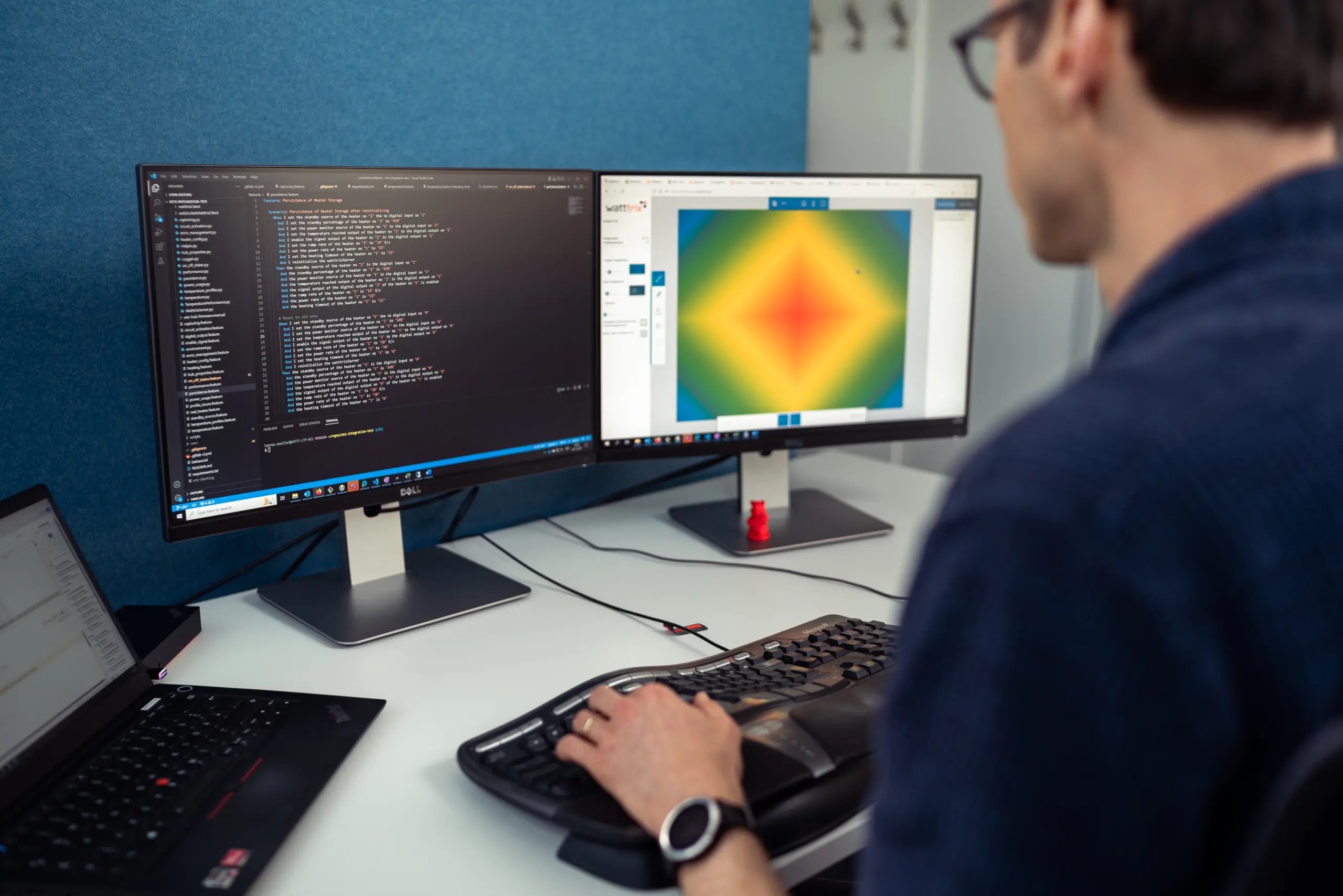
Watttron’s intelligent thermal management is an innovative temperature control system that enables precise, locally controlled temperature regulation through an array of individually controllable heating elements. The heating pixels simultaneously function as temperature sensors, enabling real-time control of temperature distribution. This innovative technology was originally developed for plastics processing in consumer packaging and is ideally suited for semiconductor applications requiring highly precise thermal management. For example, in wafer processing or the manufacturing of microelectronic components, exact temperature control is critical to ensure product quality and yield.
Key features of intelligent thermal management
Fast cooling rates:
in combination with cooling elements (currently primarily water cooling) up to 100 K/s
Extremely high heating rates:
due to the low thermal mass of the heating pixel up to 850 K/s
Precise Temperature Control:
Maintaining a temperature accuracy of 0.1 K for each pixel, even with dynamic temperature changes
Wide temperature range:
from 35°C (or colder, in combination with a cooling system) up to 700°C
Extremely high temperature gradients:
in combination with cooling, it is possible to achieve and maintain a permanent temperature difference of 280 K over a distance of 1 cm
High power density:
up to 180 W/cm²
Inert materials:
the material system was designed to have low outgassing characteristics, making it suitable for cleanrooms and UHV
In-line process monitoring:
continuous monitoring of the electrical power required to maintain the specified temperature of each heating pixel enables detection of process deviations
Expandable functionalities:
since the heating elements are developed in-house, there is the possibility to integrate additional functions such as microactuators or VIAs
Scalability:
thanks to the modular concept, the heating systems are adaptable to various tools and equipment sizes. Typical size of a heating pixel: square 5 mm × 5 mm, however other shapes and sizes are also possible
Real-time control:
integrated, process-integrated temperature sensors ensure constant process conditions
Integrated control hardware:
operation via user interface (GUI) or protocols such as EtherNet/IP, ModbusTCP, MQTT, ProfiNet
Complete system:
including heating element, control unit, and user interface for seamless operation
Worldwide support:
reliable service, wherever you are