

Rethinking material savings in the packaging industry
Rising plastic prices, increasing sustainability requirements, and high cost pressure are forcing packaging manufacturers to continuously optimize their processes. At the same time, product safety, packaging quality, and process stability remain key success factors—especially in the food industry.
But how can plastic consumption be reduced without compromising quality and product protection?
This is exactly the question that Bedford, WEBOMATIC, and watttron addressed in a joint project. The result clearly demonstrates the potential of modern thermoforming processes and digital heating technology.
Digital heating technology for optimized material distribution
In thermoforming, areas with varying material thickness often occur. Particularly with deep-drawn packaging, critical thin spots can arise that impair stability and product safety. This risk is often addressed by using thicker films, which increases material consumption and costs.
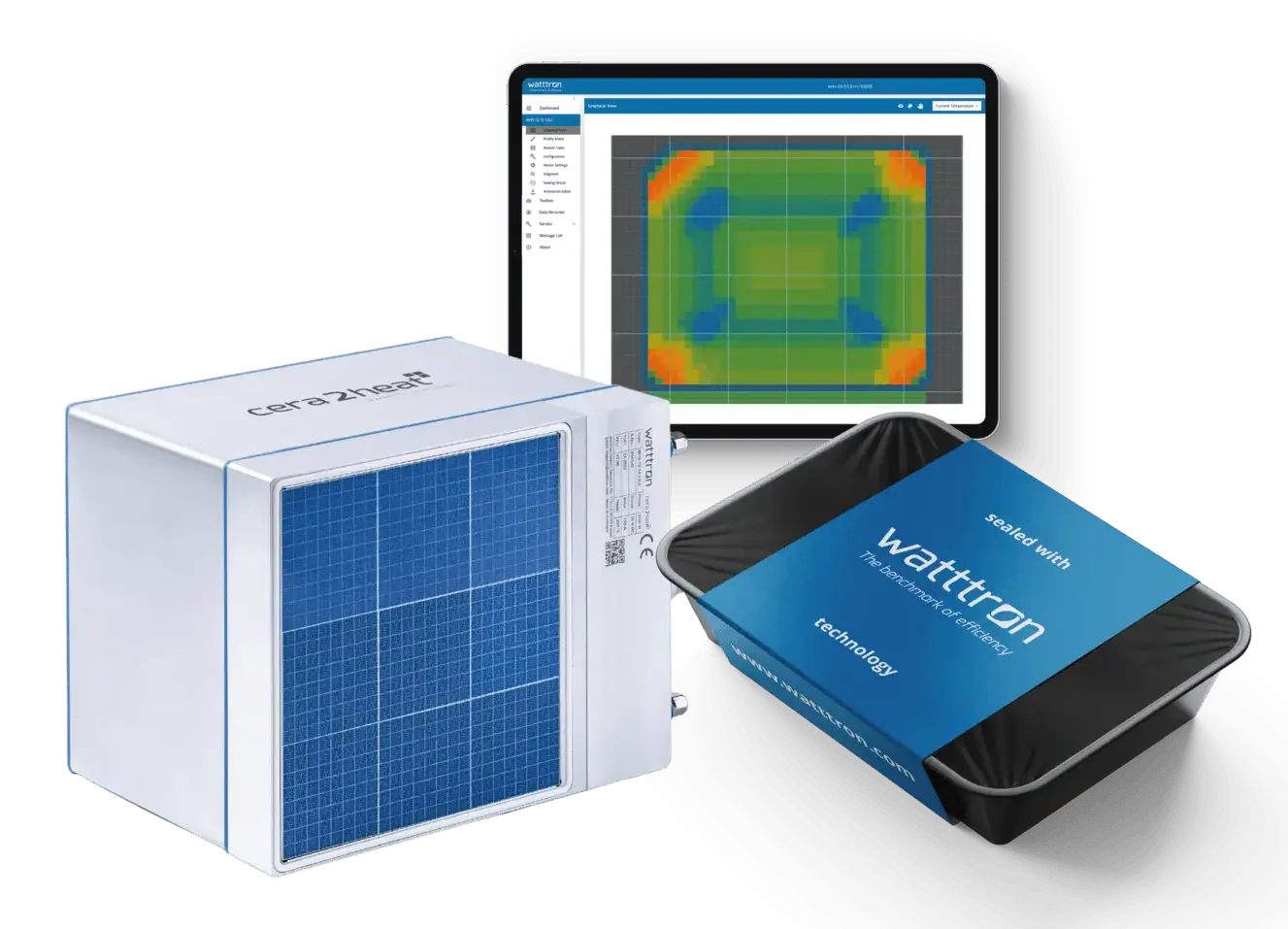
With watttron’s digital cera2heat® matrix heating technology, the temperature distribution during the thermoforming process can be controlled with pixel-level precision. This allows the plastic film to be heated in a targeted way, providing material exactly where it is needed for the finished package.
The benefits:
- More uniform material distribution
- Avoidance of critical thin spots
- Higher process reliability
- Reduced plastic consumption
- Improved sustainability and resource efficiency
Real-world example: Bedford reduces material usage by 20%
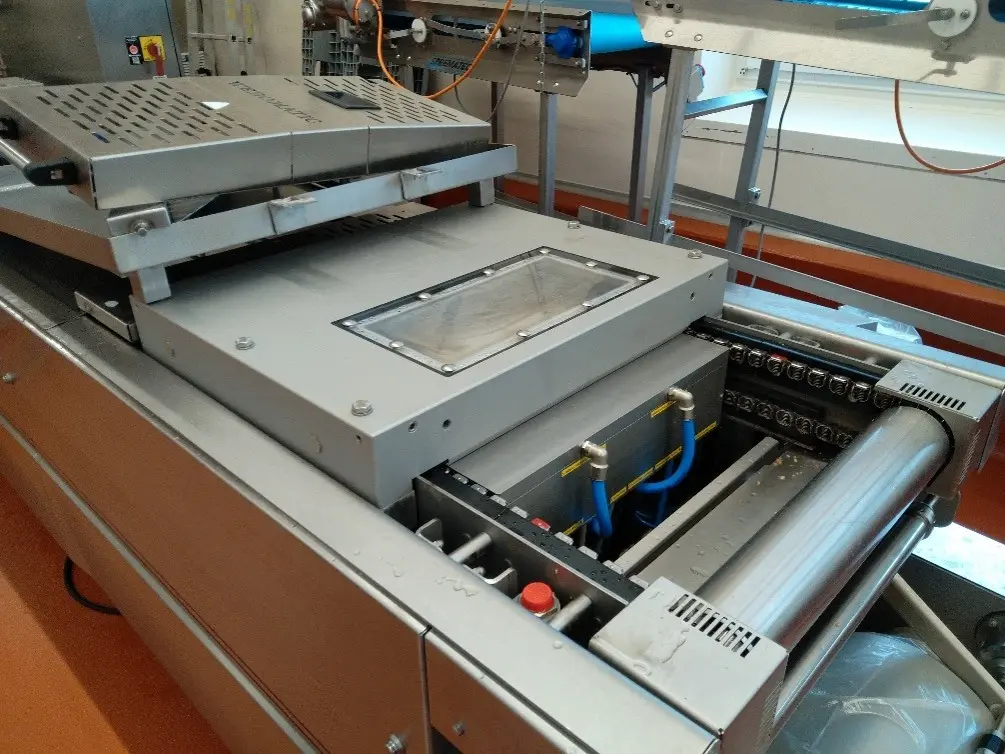
Together with the food manufacturer Bedford and the packaging machinery manufacturer WEBOMATIC, the digital heating technology was integrated into the thermoforming process.
The result: The film gauge used was reduced from 550 µm to 450 µm. This corresponds to material savings of around 20%.
At the same time, the previously critical areas of the packaging were significantly improved. Material distribution was optimized, packaging stability increased, and product safety further enhanced.
For Bedford, this means:
✅ 20% less plastic consumption
✅ Reduced packaging costs
✅ Higher product safety
✅ More sustainable packaging production
✅ Reliable performance under demanding production conditions
Why material efficiency is increasingly becoming a competitive advantage
In times of volatile raw material markets, material efficiency is becoming increasingly important. Every gram of plastic saved not only reduces material costs, but also lowers dependence on fluctuating raw material prices.
At the same time, material-efficient packaging solutions help companies achieve their sustainability goals, conserve resources, and improve their CO₂ footprint.
Modern packaging technologies such as watttron’s digital heating technology therefore make an important contribution to more economical and more sustainable packaging production.
Successful collaboration for innovative packaging solutions
The joint success story of Bedford, WEBOMATIC, and watttron shows how innovative thermoforming technology, intelligent temperature control, and collaborative partnership can deliver measurable results.
Would you like to learn how the solution was implemented in detail and what experiences the project partners had?
👉 Read the full success story in German or English.
👉 Also watch the exclusive video interview with Ulrike Stelzner (Managing Director, Bedford) and Ralf Bonk (Chief Executive Manager, WEBOMATIC) for exciting first-hand insights.